
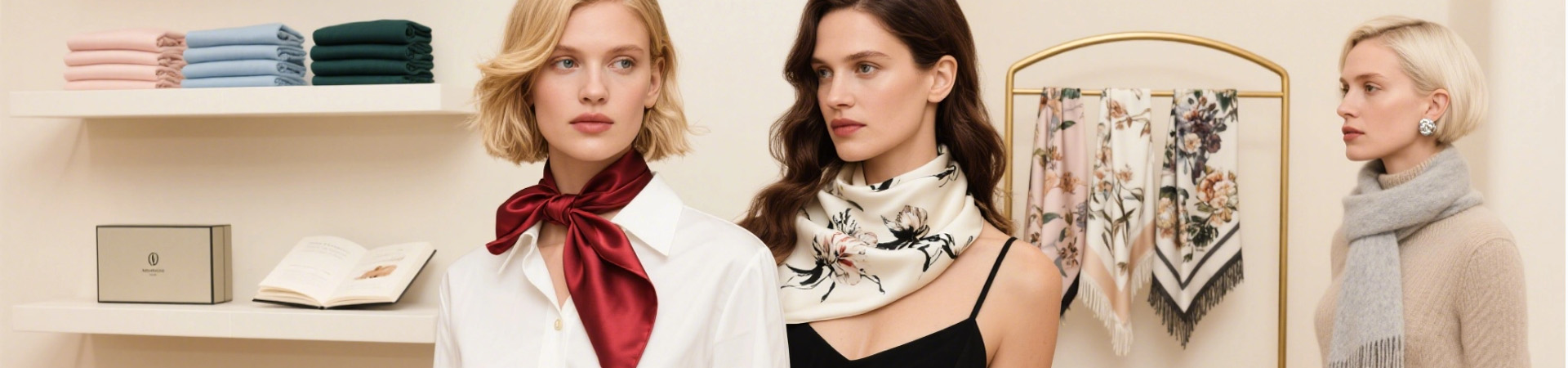
Scarf Top Trend 2026 Sourcing Custom Large Silk Scarves
Seidenschals are taking on a broader role in 2026. Beyond traditional neckwear, oversized formats are being styled as halter tops, waist wraps, pareos, and shoulder pieces, giving fashion brands more ways to build a familiar accessory into a collection.
For buyers, the opportunity goes beyond the trend itself. Once a scarf is expected to work in several styling positions, the product brief becomes more demanding. Size, drape, opacity, artwork placement, and reverse-side appearance all affect whether the finished piece still looks intentional after it is folded, tied, and worn.
That makes the sourcing question practical: what needs to change when a large silk scarf is developed as a multi-wear product rather than a single-use accessory? The answer starts with the intended use, because that decision shapes the format, silk, printing, sampling, and cost decisions that follow.
Why the Scarf Top Trend Changes the Product Brief
A scarf designed mainly for neckwear is judged largely by how it drapes and how the print appears around the neck. A multi-wear scarf has to perform in very different positions. Folding can hide key artwork, rotation can move a logo out of view, and wearing the silk against the body makes opacity and fabric weight much more noticeable. The product brief therefore needs to define the intended styling uses before size, silk weight, printing, or premium finishing are finalized.

Decide Whether Multi-Wear Adds Real Product Value
Multi-wear positioning works best when it supports the way the collection will actually be marketed. Resort collections, fashion capsules, boutique accessories, and seasonal drops are obvious examples: one scarf can appear as a neck accessory in one look and a halter or waist wrap in another.
It is not necessary for every scarf.
A smaller square built around a strong directional motif may be a better product when sold simply as an accessory. Increasing the dimensions or adding a more complex print process only makes sense when the customer will notice the difference.
The first decision is therefore commercial rather than technical: which styling uses genuinely strengthen the product offer?
Define the Intended Uses Before Sampling
Write down the main styling positions before finalizing the specification. “Neck scarf, halter top, and waist wrap” is actionable. “Make it versatile” leaves too much room for interpretation.
Each position changes what the customer sees. A triangular fold may hide the center artwork. A waist wrap can make one border the main visual area. A shoulder drape may reveal much more of the reverse side.
Once those uses are fixed, design and sourcing teams have a clearer basis for choosing shape, silk weight, print direction, and sample requirements.
Match Scarf Format and Silk to the Intended Use
The next decision is physical: which shape and fabric behavior support those styling positions? A bigger scarf or higher momme does not automatically produce a better multi-wear product. The scarf needs enough usable area for the planned folds, but it also needs suitable coverage and enough fluidity to tie cleanly without becoming bulky.
Large Square, Long, or Oblong?
Large square formats suit triangular folding, halter styling, shoulder wraps, and waist ties. For large square silk scarves, 100 × 100 cm and 110 × 110 cm formats are available, with 12, 14, 16, 19, and 22 momme silk options.
Choose a large square when folding versatility is central to the product concept.
A long or oblong format is a better fit when elongated drape, loose wrapping, or waist styling matters more than triangular folding. The shape needs to follow the intended use rather than a general assumption that more fabric is always better.
Match Drape and Coverage to the Silhouette
Material choice becomes more important when the scarf starts functioning like clothing. For langer Seidenschal projects, current options include charmeuse satin at 12–19 momme, chiffon at 6–12 momme, and georgette at 8–14 momme.
Chiffon gives lighter movement but less visual coverage, so it needs an on-body check before being approved for scarf-top use. Charmeuse provides a fuller, smoother appearance, although additional weight can create more bulk in close folds.
Do not judge opacity only while the scarf is lying on a table. A fabric that looks sufficiently covered when flat can behave very differently against the body, in movement, and under stronger lighting.
Design for What Remains Visible After Folding
Choosing the right size and silk still does not guarantee that the design will work. Customers rarely see the complete printed surface once a scarf is worn. Folding can remove half of a central motif, shift a logo away from the visible area, or make a narrow border much more prominent than expected. For maßgefertigte Seidenschals developed around multi-wear styling, artwork has to be reviewed as part of the worn product.
Protect Important Artwork and Logo Zones
A centered hero illustration may disappear inside a triangular fold. A corner logo can move behind the body. Strongly directional artwork can look wrong when the scarf is rotated.
Before sampling, create simple mockups of the positions planned for product photography or retail styling. Check where the logo lands, which sections of the border remain visible, and whether the artwork still feels balanced.

Pay attention to artwork near the finished edge as well. A narrow printed border can lose visual balance after hemming and tight tying.
Fixing these issues in the artwork file is much cheaper than discovering them after a physical sample has been made.
When Is Double-Sided Printing Worth the Cost?
Multi-wear styling often exposes more of the reverse side, which makes double-sided printing relevant for some projects.
For suitable medium-weight silk around 14–19 momme, including crepe de chine and twill, double-sided digital printing can give a clearer appearance on both faces. The process takes longer and costs more than conventional single-sided digital printing.
Use it when both sides remain visible in normal styling. If one face still dominates after folding, single-sided printing is usually the more economical specification.
Brands comparing the two approaches can review the guide to double-sided digital printing for custom silk scarves before finalizing the sample brief.
Approve the Sample and Reduce Bulk-Order Risk
The physical sample has to prove that the scarf can fold, tie, drape, and cover as planned. It also becomes the reference for bulk production, so approval needs clear checkpoints rather than a general “looks good.”
Test Every Styling Position Before Approval
If the collection will show the scarf as neckwear, a halter top, and a waist wrap, test all three.
Check finished dimensions, coverage, drape, opacity, artwork visibility, logo position, hem appearance, and edge behavior. If one use case fails, adjust it before bulk production.
Keep the approved artwork, measurements, color reference, finishing instructions, and physical sample where practical. These provide a clearer benchmark for bulk consistency.
Confirm QC and Lead Time Before Bulk Production
For long-scarf orders at Xinhe Textiles, inspection runs through four stages from silk base selection to final packaging.
One current production reference is about 4–5 working days for sampling and 12–14 working days for 1,000 machine-hemmed scarves. This is not a universal lead time. Artwork revisions, material choice, printing, finishing, quantity, packaging, and shipping can change the schedule.
For launch-driven projects, confirm timing against the final specification. Under the current customized-scarf policy, damaged, defective, or incorrectly customized goods can be submitted for exchange or remake within 7–14 days after delivery, normally with photo or video evidence.
Compare Total Project Value, Not Just Unit Price
Once the specification and sample are fixed, supplier quotations become easier to compare. Before that, a lower price may simply reflect less silk, lighter construction, simpler printing, basic finishing, or different packaging.
What Actually Raises the Project Cost?
Larger dimensions increase silk consumption. Double-sided printing adds process complexity. Premium edge finishing adds labor, while extra sampling and bulky packaging add development or freight cost.
The right specification is not the one with the most upgrades. If heavier silk makes a wrap harder to tie, the higher-cost material is working against the product. Each upgrade needs a clear reason—better coverage, styling, presentation, or another benefit the customer will actually notice.
Send a Complete RFQ to a Silk Scarf Manufacturer
Once the product use, sample expectations, and timing are clear, the RFQ can be concise. A Seidenschal-Hersteller needs enough information to quote the intended product and make different supplier quotations genuinely comparable.
What to Include in the First Inquiry
Send:
-
artwork or design concept
-
intended styling positions
-
target format and dimensions
-
preferred hand feel or fabric reference
-
printing and branding requirements
-
estimated quantity
-
required delivery date
Include a styling sketch when the folds are important. “110 cm square scarf for neck, halter, and waist styling” gives clearer direction than “please quote a large scarf.”
If the specification is still open, custom silk scarf projects can include silk selection, printing, hemming, labels, hangtags, and packaging. Confirm which branded details need to appear on the approval sample before bulk production.
Abschluss
The scarf top trend gives fashion brands a timely reason to rethink the silk scarf as more than a traditional accessory. The opportunity comes from making the product work convincingly in several styling positions—not from simply increasing the size or adding every premium option.
A successful large silk scarf needs the right balance of format, drape, coverage, artwork, printing, finishing, cost, and timing. Brands developing maßgefertigte Seidenschals, private-label accessories, or wholesale silk scarves can send Xinhe Textiles their project details—including artwork, intended styling positions, dimensions, quantity, and delivery window—to discuss sampling and receive a project-specific quotation.
Häufig gestellte Fragen
Q1: What scarf format works best for multi-wear styling?
A: Choose a large square for triangular folding, halter styling, and wraps. Choose a long or oblong format when elongated drape or waist wrapping matters more.
Q2: How can brands keep artwork visible when a silk scarf is folded or wrapped?
A: Review the design in the actual folding positions before sampling. Check center motifs, borders, logos, and directional artwork because a design that works flat can lose its focal point after folding.
Q3: When is double-sided printing worth the extra cost for a multi-wear silk scarf?
A: Use it when both faces remain clearly visible during normal styling. If one side remains dominant, single-sided printing is usually the more economical choice.
Q4: How long do custom silk scarf sampling and bulk production take?
A: Timing depends on the specification. One long-scarf reference is about 4–5 working days for sampling and 12–14 working days for 1,000 machine-hemmed pieces. Confirm timing after fabric, printing, finishing, quantity, and packaging are fixed.
Q5: What information does a silk scarf manufacturer need for an accurate quote?
A: Send artwork, intended uses, target dimensions, material expectations, printing and branding requirements, estimated quantity, packaging needs, and delivery date. Styling references help when several wearing positions are planned.


