
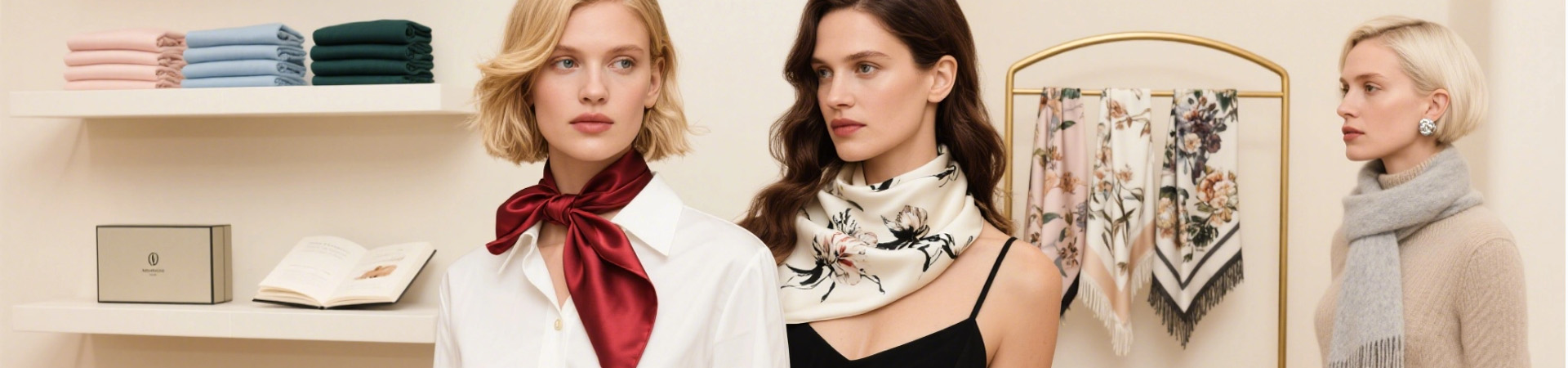
2026 EU DPP Silk Scarf Supplier Checklist by Xinhe Textiles
A Seidentuch order usually starts with artwork, a fabric swatch, a target price, and a delivery date. For products intended for the European Union, buyers increasingly need a clear link between the finished scarf, its silk fabric specification, the approved sample, the production batch, and the company placing it on the market.
Ordinary silk scarves are not currently subject to a textile-specific Digital Product Passport requirement. Still, DPP readiness should begin during fabric selection, sampling, and purchase-order confirmation—not when a QR code is added to a hangtag.

What EU DPP Readiness Means for Silk Scarf Buyers in 2026
The DPP Registry Is Live, but Textile Rules Are Still Forthcoming
The EU Digital Product Passport Registry became operational on July 20, 2026. It stores unique product identifiers, registration data, and high-level metadata rather than the complete product information contained in each DPP. Detailed product data remains decentralized and is maintained by the relevant economic operator or its DPP service provider.
The European Commission’s current textile-specific implementation timeline indicates Q4 2027 for the planned adoption of the ESPR delegated act for textiles. Following adoption, economic operators are expected to receive a transition period of at least 18 months. The timeline remains indicative and may change as legislative and technical work progresses.
A QR code alone would not establish compliance with future textile DPP requirements. For sourcing teams, preparation means building accurate product specifications, approval records, supplier files, and batch references before the final requirements take effect.
Finished Silk Scarves Depend on Upstream Silk Fabric Data
According to the May 2026 JRC preparatory study, scarves, neckerchiefs, headscarves, and shawls fall within the proposed scope for textile apparel accessories. Under the same proposed approach, fabrics, yarns, and fibers are treated as intermediate products and fall outside the proposed direct scope for finished-product DPPs.
The study is preparatory and does not establish the final legal scope. Final product coverage, data requirements, and implementation details will depend on the textile delegated act.
Even so, upstream silk fabric records remain practically important. Fiber composition, material specifications, sourcing information, and other supplier data may be needed to support the finished scarf’s future DPP. Brands and importers therefore need reliable information from their silk scarf manufacturer, even when that supplier is not the economic operator placing the product on the EU market.
A Practical Silk Scarf Supplier Documentation Checklist
A useful order file should answer three simple questions:
-
What did the buyer order?
-
What did the buyer approve?
-
What did the factory produce?
| Record area | Information to confirm | Why it matters |
| Product identity | Style number, SKU, size, colorway, and PO reference | Connects the scarf to the correct product file |
| Material | Fiber composition, silk construction, momme, and fabric reference | Supports labeling, quotations, and reorders |
| Artwork | Version number, placement, color reference, and approval date | Prevents outdated artwork from entering production |
| Production | Batch reference, print method, hemming, and finishing | Links the product to the correct production run |
| Quality | Approved sample, tolerances, inspections, and relevant tests, where applicable | Sets the bulk acceptance standard |
| Markenbildung | Care label, brand label, hangtag, packaging, and carton marks | Keeps retail and shipping details consistent |
| Revisions | Change date, reason, revised file, and buyer approval | Creates a usable change history |
A large spreadsheet is not necessarily a reliable record. The same style reference should appear on the specification sheet, approved sample, purchase order, packing list, and inspection report.
When every document uses a different code, the information trail breaks.
Separate Model and Batch Information
Shared product details normally sit at model level. For example:
65 × 65 cm, 100% silk twill, 14 momme, hand-rolled edge.
Batch-level information may include the colorways, production date, facility, purchase order, inspection date, and test record for a particular production run.
Item-level identification is more detailed and is not standard for most conventional scarf orders. Whether it will be required for specific silk scarf products will depend on the final textile rules.
Link the Approved Sample to Bulk Production
Consider a private-label order for one 65 × 65 cm scarf in three colorways. One color is approved immediately. The second needs a warmer red, while the third uses a revised logo position.
When every file is named “final artwork,” the wrong version can easily reach production.
A reliable silk scarf supplier should carry the same style code from sampling to final inspection. Each colorway needs its own artwork version and approval date. Changes to fabric, momme, size, print position, reverse-side appearance, hemming, labels, or packaging should be approved before bulk production continues.
Brands preparing an initial collection can review Xinhe Textiles’ idea-to-sample-to-first-production-run guide before issuing a purchase order.
Product Specifications Buyers Should Record for DPP Readiness
Silk Fabric, Momme Weight, and Finished Size
“Premium silk” is a sales phrase, not a production specification.

The order file should state the actual silk construction, momme weight, finished dimensions, and acceptable tolerance. These details affect drape, opacity, print performance, pricing, and packing weight.
Buyers can compare silk satin, silk habotai, silk georgette, silk chiffon, silk organza, and other constructions through Xinhe Textiles’ silk fabric collection. The fabric should match the product brief rather than being selected by name alone.
A scarf made from a heavier silk construction will behave differently from a lightweight silk habotai or silk chiffon design. For wholesale silk scarves, buyers should fix the fabric and momme before comparing quotations. Otherwise, two suppliers may be pricing noticeably different products.
Printing Method and Reverse-Side Appearance
“Digital printing” is not a complete production instruction.
The specification should identify whether the project requires:
-
Standard digital printing;
-
Stronger reverse-side color penetration;
-
Double-sided digital printing;
-
A specific artwork orientation or placement;
-
A physical color or sample approval.
A scarf folds and moves when worn, so the reverse side remains visible. Buyers developing premium accessories can review how double-sided digital printing works for custom silk scarves.
The approved production file should also carry the artwork version, color reference, finished size, and sample code. For wholesale silk scarves, those details should be settled before the buyer compares prices.
Hemming, Labels, and Packaging
Edge finishing should appear on the quotation, approved sample, and bulk production sheet. Common choices include hand-rolled, machine-hemmed, and imitation hand-rolled edges.
The same rule applies to:
-
Fiber and care labels;
-
Brand labels and hangtags;
-
Barcode or SKU labels;
-
Individual bags or boxes;
-
Carton quantities and shipping marks.
Do not use one SKU or specification record for two scarf sizes simply because the artwork is identical. A 70 × 70 cm scarf and a 90 × 90 cm scarf should normally be managed as separate product variants. Final DPP granularity—whether at model, batch, or item level—will depend on the textile delegated act.
How to Check a Silk Scarf Manufacturer Before Placing a Purchase Order
A sourcing manager does not need a complicated software presentation during the first supplier meeting. A few practical questions usually reveal whether the factory has a workable document trail.
| Buyer question | Positive sign | Warning sign |
| How are artwork revisions controlled? | Each file has a version, date, and approval | Files are named only “final” or “latest” |
| Can the sample be linked to the bulk batch? | One style reference appears across the sample, PO, and inspection record | Sampling and production use unrelated codes |
| What test documents are available? | The supplier identifies the test, date, material, and product scope | The answer is simply “all tests passed” |
| How are substitutions handled? | The buyer approves a revised specification before production | A “similar” fabric may be used without approval |
| How are colorways separated? | Each colorway has its own artwork and approval reference | All colors share one general production file |
A general factory certificate does not replace an order-specific specification. A test report for one fabric should not automatically be presented as proof for every silk scarf produced by the supplier.
Ask the Seidenschal-Hersteller which document applies to the exact fabric, style, and batch being ordered.
How Xinhe Textiles Supports Custom Silk Scarf Procurement
Founded in 2017, Xinhe Textilien supplies silk fabrics and finished silk scarves for international custom projects. Its production workflow includes artwork confirmation, physical pre-production sampling, bulk production after sample approval, and three inspection rounds from printing through sewing.
Through its custom silk scarf service, buyers can discuss 100% natural mulberry silk fabrics, selected silk blends, scarf dimensions, conventional or double-sided digital printing, and different edge finishes. Available finishing options include hand-rolled, machine-hemmed, and imitation hand-rolled edges, together with labels, hangtags, and packaging.
Selected projects can support low minimum quantities. Actual MOQ, lead time, pricing, and available production options depend on the fabric, artwork, printing method, edge finish, packaging, and quantity allocated to each design.
These stages create useful checkpoints for private label silk scarves:
-
Artwork and product specifications can be reviewed before sampling;
-
A physical sample can serve as the reference for bulk production;
-
Printing, hemming, labels, and packaging can be confirmed before production;
-
Quality inspections can be completed before shipment.
Available certificates, product specifications, inspection records, and testing documents should be confirmed for each order because requirements vary by product, destination market, and buyer request.
Abschluss
Digital Product Passport preparation is built on practical sourcing discipline: a clear silk fabric specification, controlled artwork, an approved sample, batch references, accurate labels, and records that match the finished product.
For brands and importers, choosing the right silk scarf supplier can reduce production errors, make reorders more predictable, and limit future information gaps. Share your artwork, preferred silk, dimensions, estimated quantity, target market, labeling needs, and requested documents with Xinhe Textiles to request a tailored quotation and discuss the next sampling step.
Häufig gestellte Fragen
Q1: Are silk scarves required to have an EU Digital Product Passport in 2026?
A: No textile-specific DPP requirement currently applies to ordinary silk scarves in 2026. The European Commission’s textile-specific timeline indicates Q4 2027 for the planned adoption of the delegated act, followed by a transition period of at least 18 months. The timeline remains indicative.
Q2: When could EU textile DPP requirements begin to apply?
A: The exact compliance date has not yet been fixed. Requirements could apply only after the textile delegated act is adopted and the transition period has ended. The final date, product scope, and data requirements will depend on the adopted legislation.
Q3: Who may be responsible for imported silk scarves?
A: Under the current ESPR framework, primary responsibility generally lies with the manufacturer placing the product on the EU market or, when that manufacturer is not established in the EU, with the importer. Authorized representatives and other economic operators may have specific duties depending on their role, mandate, and the final textile rules.
Q4: What documents should an importer request from a silk scarf supplier?
A: Request the product specification, fiber composition, silk construction, momme, approved artwork, sample approval, batch reference, labels, packaging instructions, inspection records, and relevant test reports where applicable. These documents should use the same style or order reference.
Q5: Is a QR code enough to make a silk scarf DPP-ready?
A: No. A QR code is only a data carrier. The product identifier, responsible economic operator, required product data, and supporting records must be accurate, accessible, and connected to the correct product. The final textile delegated act will determine the exact information requirements.

