
Custom Skinny Silk Scarves for Handbags in 2026 Wholesale Sourcing Guide for Fashion Brands
Custom Skinny Silk Scarves for Handbags in 2026 Wholesale Sourcing Guide for Fashion Brands
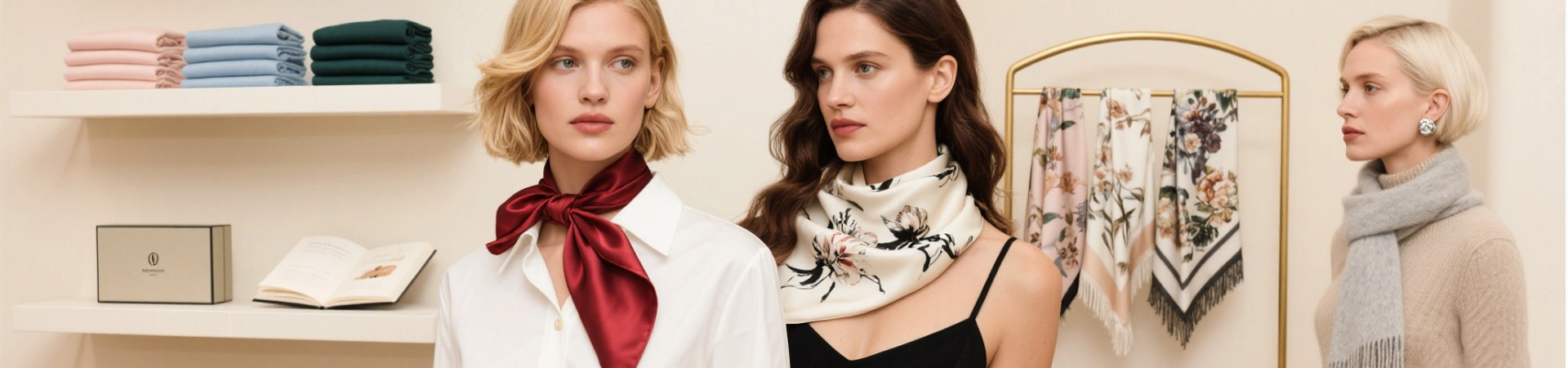
Small-format scarves are getting more attention in 2026, especially in handbag and accessory styling. For B2B buyers, that creates a product opportunity—but not one that should be treated as a scaled-down square scarf. A narrow silk format has less room for artwork, borders, logos, and finishing, so proportion and sample testing matter from the start.
For fashion labels, handbag brands, gift programs, and accessory buyers, a custom skinny silk scarf can carry seasonal color, printed artwork, or subtle branding without adding a large new product category. Xinhe tekstiilid develops silk fabrics and customized scarves for international fashion and accessory projects.
Small-Format Silk Scarves in the 2026 Accessories Market
The current scarf revival gives product teams a timely reason to look again at narrow formats. Consumer search activity, runway styling, and luxury-brand assortment decisions are all pointing toward renewed interest in scarves, though these signals should not be confused with direct wholesale demand. For procurement teams, the useful part is seeing where styling attention is moving and then deciding whether a small-format scarf fits an existing handbag, accessory, or private label collection.
Search Momentum Around Scarf-on-Bag Styling
Pinterest’s Summer 2026 trend data recorded a 217% increase in searches for “scarf on bags” and a 112% increase for “tiny scarf.” Searches for “Italian silk scarf” also rose 129%. These are discovery trends rather than B2B sales figures, but they show clear interest in smaller scarves and new styling applications.

Runway coverage has moved in a similar direction. Vogue’s 2026 scarf coverage showed scarves used as bandanas, belts, hair accessories, and layered styling pieces rather than only traditional neckwear.
That wider styling language gives a custom handbag scarf more room to work across seasonal campaigns, bag launches, and accessory capsules.
A Commercial Signal From Luxury Scarf Assortments
There is also a useful B2B signal from the luxury market. Burberry reported that scarves and outerwear both grew by double digits in the second half of FY2025/26 and said it was expanding its lightweight silk scarf assortment as part of a year-round offer.
One company’s results do not define the whole market, but they reinforce an important point for product teams: scarves are being treated as a meaningful accessory category, not simply a seasonal add-on.
For a handbag or fashion brand, a private label skinny silk scarf can extend an existing collection through print and color without requiring the visual scale of a full-size square scarf.
How Skinny Silk Scarves Differ From Standard Silk Scarves
A narrow scarf creates different design and production decisions from a standard square scarf. Width affects the apparent scale of motifs, while length changes how the piece ties, wraps, and falls. Fabric behavior becomes more noticeable too, because the finished product may be knotted tightly or wrapped several times around a handle. These differences are why a skinny silk scarf wholesale project should be developed around its intended use rather than copied from a larger scarf specification.
Size and Proportion for Bag-Handle and Multi-Use Applications
There is no single standard dimension that suits every bag handle silk scarf. A piece designed mainly for wrapping a handbag handle may need different proportions from one intended for neck, hair, or wrist styling.
The practical question is whether the proposed length and width work after tying. A narrow scarf that looks well balanced when laid flat can feel bulky at the knot, or leave too little visible artwork once wrapped.
Xinhe’s long silk scarf range provides a useful product-development reference for elongated silk formats and customized printing. The final dimensions for a narrow handbag scarf should still be confirmed on a physical sample rather than selected from a standard size chart.
A few centimeters can make more difference here than many buyers expect.
Fabric Structure for Narrow-Format Printing and Tying
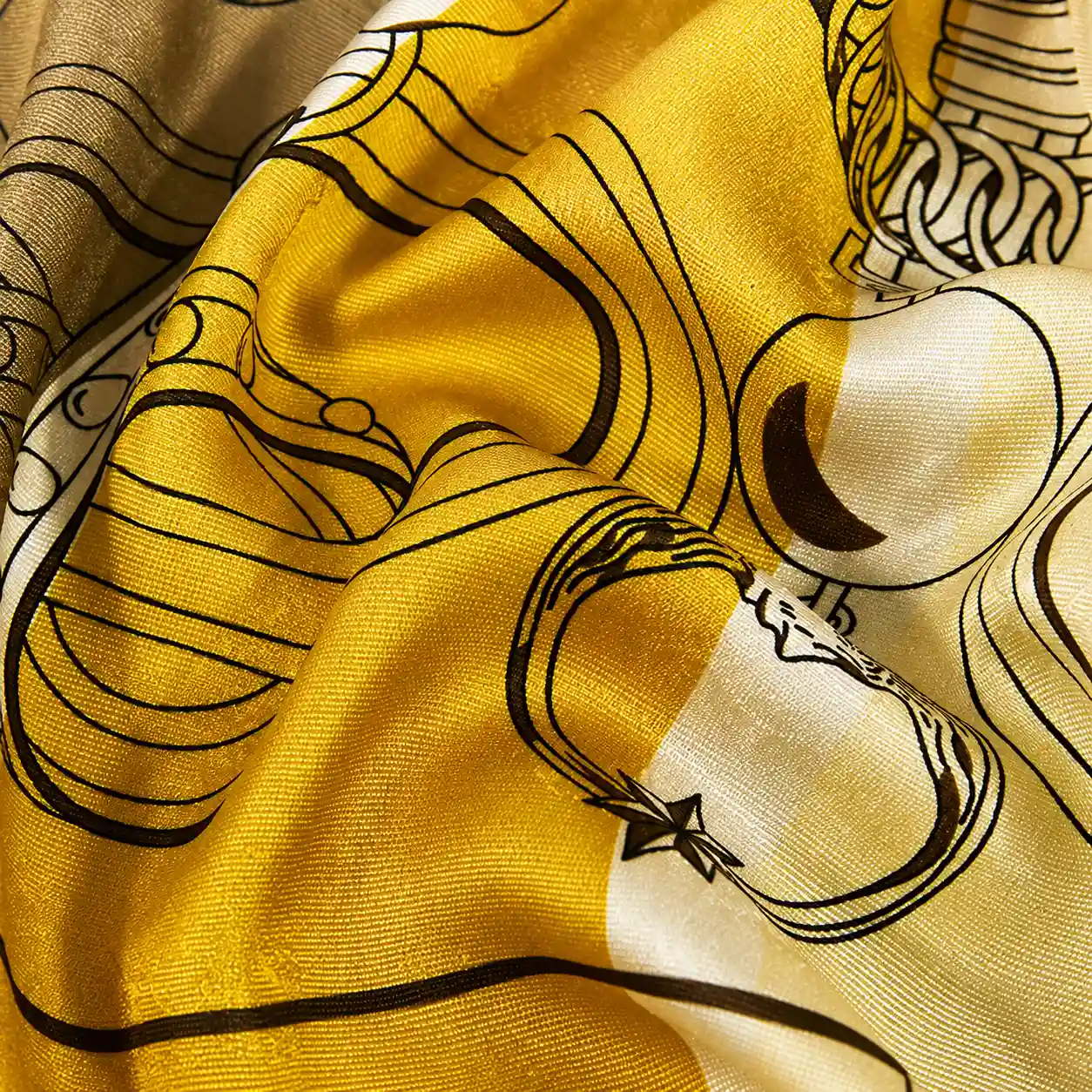
Fabric choice should follow the way the finished scarf needs to behave. For a narrow printed scarf, buyers should look at knot shape, drape, surface character, artwork definition, and how the material responds when folded repeatedly.
Silk twill is one option when a project calls for more body and a more defined surface than some lighter silk constructions. Xinhe also produces silk twill scarves, which gives brands a relevant starting point when evaluating this fabric direction.
The fabric name should not be the final decision, though. Weight, finished width, edge treatment, and artwork all affect the result. The safest buying decision comes from testing the actual combination.
Custom Development for Narrow Silk Scarf Formats
Once size and fabric direction are reasonably clear, artwork becomes the central development issue. A long, narrow canvas cannot carry visual information in the same way as a 70 × 70 cm or 90 × 90 cm square. Motifs may need to repeat more often, borders become proportionally larger, and a logo can disappear completely after tying. For brands developing a custom skinny silk scarf, artwork should therefore be reviewed in both flat and worn positions before production files are approved.
Artwork Scaling and Repeat Placement
Large motifs often lose impact when they are compressed into a narrow format. A design that looks elegant at full scale may show only fragments once the scarf is wrapped around a handbag handle.
Repeated graphics, smaller motifs, linear compositions, and carefully placed borders can work more naturally on the available surface. The right choice depends on the brand identity rather than one universal design rule.
During development, it is useful to review the scarf in three states:
-
fully open;
-
tied in a simple knot;
-
wrapped around an actual handbag handle.
That third view is especially important for a custom bag scarf. If the product will mostly be seen on a bag, the artwork should be approved in that context.
Logo Placement and Brand Visibility
Logo placement needs the same practical treatment. A large mark in the center of the artwork may disappear after wrapping, while a smaller mark near a strategically visible section can stay recognizable without dominating the design.
For a custom silk scarf with logo, sample approval should check scale, location, border relationship, and visibility after tying.
Xinhe’s custom silk scarf service supports digital and double-sided digital printing together with different edge-finishing and private label options. These details are most useful when selected around the collection brief, not added simply because they are available.
Wholesale Sourcing and Sample Approval
After the design stage, the focus shifts to production consistency. Small-format accessories may use less fabric than a large scarf, but their compact proportions can make alignment, edge quality, and logo positioning more noticeable. A professional sourcing process should therefore define what is being approved at sample stage and carry that approved specification into bulk production. This matters for a first launch, and even more for collections expected to add repeat colors or new prints later.
What Buyers Should Check in a Physical Sample
A sample should be tested in real use.
For a handbag-focused scarf, wrap it around a real handle and check whether the main artwork still reads clearly. Look at the logo position, visible border, finished width, knot bulk, edge symmetry, print alignment, and reverse-side appearance.
Color should also be reviewed together with the selected fabric, not as a screen image alone.
This kind of test often catches issues that are invisible in a flat mockup. A design may be technically correct yet still need a small placement adjustment before bulk production.
Supplier Capability and RFQ Preparation
When comparing a skinny scarf manufacturer or custom silk scarf manufacturer, procurement teams should focus on whether the supplier can carry an approved specification consistently from pre-production sampling into bulk and repeat orders.
A clear RFQ should normally include:
-
target dimensions;
-
fabric preference or performance requirement;
-
artwork file;
-
quantity per design or color;
-
printing and edge-finishing requirements;
-
logo or private label details;
-
packaging and delivery requirements.
If fabric or size is still open, that is fine. It is better to identify an undecided specification during development than approve the wrong one just to complete a quotation.
Kokkuvõte
The 2026 interest around scarf on bags, tiny scarves, and lightweight silk accessories gives fashion and handbag brands a strong reason to explore small-format scarf development. The trend creates visibility; product execution determines whether the idea works commercially.
For B2B buyers, a successful custom skinny silk scarf comes down to proportion, fabric behavior, artwork scale, logo placement, finishing, and physical sample testing. In a handbag application, the scarf should be evaluated on the bag—not only on a table.
Xinhe Textiles works with customized silk scarf projects from artwork development through sampling and production. Brands preparing a narrow scarf, handbag scarf, or private label accessory project can contact Xinhe Textiles for project review and quotation.
KKK
Q1: What size works for a skinny silk scarf used on handbags?
A: There is no single standard size for every handbag application. The right length and width depend on whether the scarf will be wrapped around a handle, tied as an accent, or designed for several styling uses. A physical sample is the most reliable way to confirm proportion.
Q2: Can a skinny silk scarf be customized with a brand logo?
A: Yes. Logo placement can be built into the artwork. For handbag use, the position should be checked after tying so the logo remains appropriately visible in the finished styling.
Q3: Which silk fabric works well for a narrow printed scarf?
A: The choice depends on the required body, drape, surface character, print effect, and tying behavior. Silk twill is one option, while other silk constructions may suit different product directions. The final specification should be tested as a finished sample.
Q4: What should buyers check in a custom skinny silk scarf sample?
A: Finished dimensions, artwork placement, logo visibility, print alignment, edge finishing, knot behavior, color, and reverse-side appearance should all be reviewed. For a custom handbag scarf, the sample should also be tested directly on the intended type of bag handle.
Q5: How should fashion brands choose a skinny scarf manufacturer?
A: A suitable supplier should be able to work from original artwork, develop a physical sample, handle the required printing and finishing methods, and reproduce the approved specification in bulk production. Clear sampling and approval procedures are particularly important for narrow-format scarf projects.

